

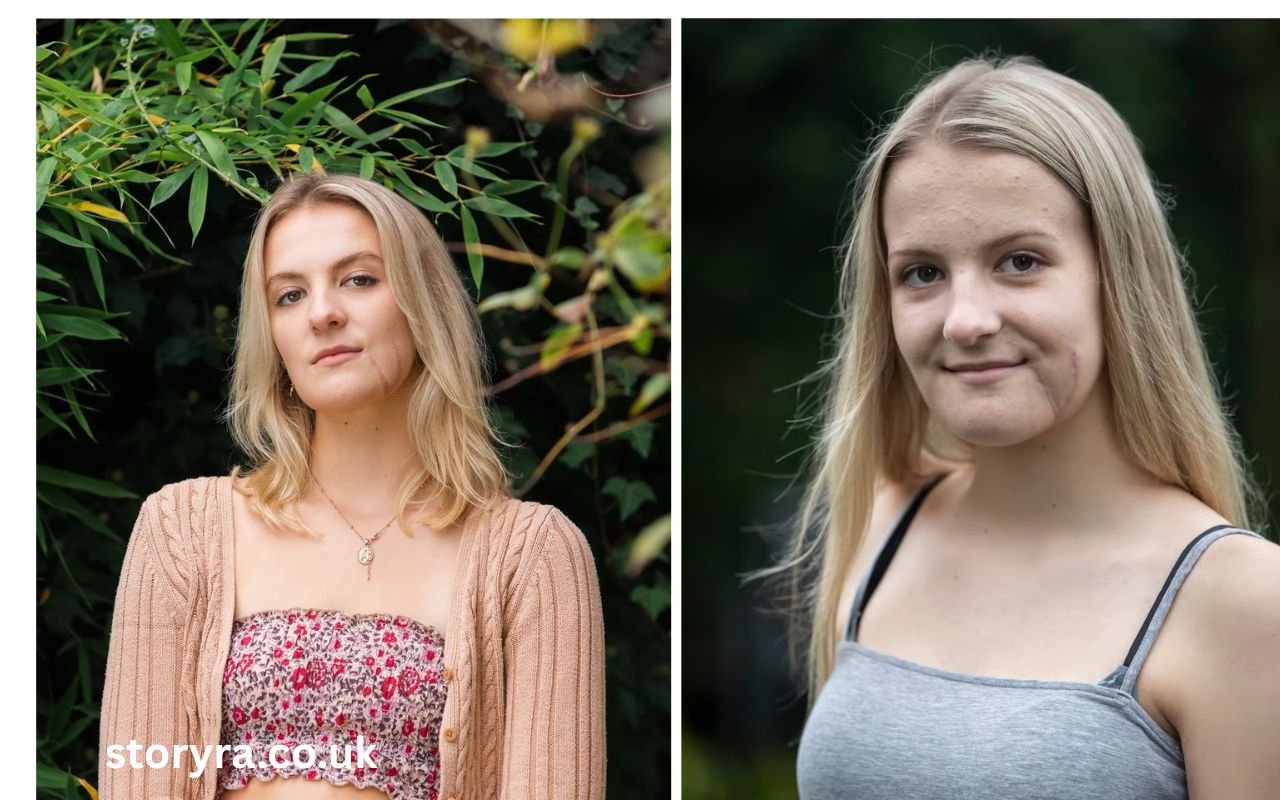
Emily Eccles Injury The Miraculous Survival Story That Shocked Britain
The Day That Changed Everything in Derbyshire
In August 2019, a seemingly ordinary horse riding trip turned into a living nightmare for fifteen year old Emily Eccles near Baslow in Derbyshire. She was enjoying a sunny day out riding with a friend and her family when a passing car spooked her horse. The sudden pop of the vehicle’s exhaust caused the animal to bolt unexpectedly, galloping at high speed along a narrow country path. In the terrifying chaos that followed, Emily’s feet slipped completely out of her stirrups, throwing her violently to one side of the horse. She smashed her head directly into a solid wooden gatepost with devastating, life altering force. The impact was so catastrophic that it ripped the entire left side of her lower jaw away from her face .
Despite the horror of the impact, Emily remained conscious. She later recalled seeing something red flashing in front of her face during the fall. When she looked down at her hands, she experienced a moment of surreal horror, she found herself holding the bottom portion of her own face, the jawbone and surrounding flesh dangling grotesquely from her palms. In a desperate act of survival, the teenager realized she was cupping her own jaw with her hands to prevent it from detaching completely from her head. As paramedics loaded her into the ambulance, she looked down again and saw exposed teeth and white bone poking through the torn flesh, leading her to ask the paramedic a heartbreaking question, is that my jaw ?
The severity of Emily Eccles’ injury was almost incomprehensible to the medical team that received her. Surgeons later described the wound as one of the worst facial traumas they had ever witnessed in a child outside of an active war zone. The only thing keeping the bottom half of her face attached to her head was a single, fragile strip of skin measuring just one centimetre wide. The nerves supplying sensation to her lip and chin were torn completely on both sides, and the branches of the facial nerve that control the movement of the lower lip were severed entirely. She was moments away from losing her jaw forever.
The Critical Emergency Response
Following the accident near Baslow, emergency services rushed to the scene with incredible urgency. Although the air ambulance was called to the location, medical personnel decided that transport by road ambulance was the safest option given the severity of the injury and the fact that the helicopter required a landing zone in a nearby park. Every bump in the road was agony, but the paramedics worked tirelessly to stabilize Emily and prevent her jaw from detaching further. She was rushed to the Sheffield Children’s Hospital, a specialist center renowned for handling complex pediatric trauma cases and facial reconstructions. The medical team immediately recognized that time was of the essence if they were to save her ability to eat, speak, and function normally for the rest of her life .
When Emily’s parents, Michelle and Chris, received the phone call, they were driving together. The caller simply said, “There’s been an accident. I’m so sorry. It’s Emily.” They rushed to the hospital in a state of pure panic and disbelief. Upon arrival, a nurse pulled Michelle aside to prepare her mentally for what she was about to see in that hospital room. Despite the grim warning, walking into the room was still a shock that took her breath away. “It’s your daughter there in a critical condition and looking very poorly and quite gruesome as well,” Michelle later recalled in interviews. She focused entirely on Emily’s eyes, which were still the same familiar eyes, giving her a gentle kiss on the forehead while reassuring her that everything would be alright .
Remarkably, despite the trauma and the shocking nature of her appearance, Emily’s sense of humor remained completely intact. When her father saw her for the first time, he managed to joke through his tears, “Em, you don’t do anything by halves.” Emily responded with a mock exasperated sigh and a weak smile, a moment of levity that helped her parents cope with the crisis. This mental resilience and the quick thinking of the paramedics helped stabilize her condition just enough for her to undergo emergency surgery. The race against the clock had begun.
The Devastating Nature of the Jaw Injury
The specifics of Emily Eccles’ fracture were almost beyond medical comprehension, even for the experienced surgeons at Sheffield Children’s Hospital. According to her lead surgeon, Ricardo Mohammed-Ali, the entire left side of her lower jaw had been pulled completely away from her face, starting from the front of the jaw all the way back to the joint near her ear. The only tissue preventing a complete amputation was that single centimetre of skin located near the hinge of the jaw. In addition to the catastrophic bone and tissue damage, the muscles that control the movement of the lower lip were severed, and the nerves responsible for feeling in her chin and lip were ripped apart like torn wires .
While the external appearance was gruesome enough to make even seasoned paramedics pause, the internal damage was equally catastrophic. The impact had driven fragments of her jawbone and shattered teeth deep into the soft tissues of her cheek and her tongue. Her tongue itself had been partially torn by the force of the impact and the sharp edges of the broken bone. There was a serious risk that fragments of bone had been driven into critical areas that could affect her airway or her ability to swallow, which could have been fatal. The dental damage was severe, with multiple teeth broken at the gum line or driven up into the jawbone itself, requiring complex extraction and future reconstruction .
Doctors later noted that Emily was incredibly lucky to be alive. The wooden gatepost she hit was located right next to a metal spike. If she had impacted that spike, or even if her entry angle had been a single centimetre different, the injury would have been fatal or would have resulted in the complete, unrecoverable loss of her jaw. The precise nature of the break, while horrific beyond words, left just enough tissue and bone structure for the surgical team to attempt a full reconstruction. It was a narrow margin between survival and a life altering disability.
The Life-Saving Surgical Reconstruction
Just hours after the accident, Emily Eccles was wheeled into an operating theatre at Sheffield Children’s Hospital. The surgery was led by consultant facial reconstructive surgeon Ricardo Mohammed-Ali, who later described the case as the most significant pediatric facial trauma he had ever encountered outside of a conflict zone. The pressure on the team was immense; one wrong move could sever the remaining skin bridge or misalign the jaw permanently. The operation lasted five and a half grueling hours, during which the team worked meticulously under a microscope to piece the shattered segments of her jaw back into their correct anatomical positions.
The reconstruction involved the placement of three titanium plates to stabilize the multiple fractures across her jawbone. Titanium was chosen for its exceptional strength and biocompatibility; it is rigid enough to hold the bone fragments in place while they heal over many months and does not react negatively with the body’s tissues. The plates were carefully screwed into the healthy parts of the jawbone to create a strong internal framework. Following the delicate bone work, the surgeon then used over one hundred and sixty individual sutures to meticulously reattach the muscles, nerves, and layers of skin. Despite the severity of the accident, the team managed to save all but one of Emily’s teeth, a remarkable outcome.
The nerve damage was the most complex and uncertain aspect of the entire repair. The nerves that had been torn were carefully approximated under a microscope in the hopes that they would regenerate naturally over time. While the surgery saved her face structurally, the surgeon knew that full sensation in her lip and chin might never return completely. However, the primary goal was achieved against all odds: the jaw was back in place, the blood flow was restored, and the risk of amputation was eliminated. The surgery was so precise that six days later, when the heavy bandages came off for the first time, Emily and her parents saw that everything, though horribly swollen, was exactly where it should be.
The Miraculous Recovery and Return to School
Read More : Sara Jane Rogers The Quiet Life of General Hospital Star Tristan Rogers’ Daughter
The speed of Emily Eccles’ recovery shocked even her medical team, who had prepared her for a long and difficult rehabilitation. Just eleven days after the most traumatic day of her life, she was discharged from the hospital to continue her recovery at home, eating soft foods and sleeping elevated to reduce swelling. One month after the accident, she achieved a milestone that seemed impossible in the immediate aftermath of the crash, she returned to Wales High School near Sheffield to start the new school term. Walking back into the classroom was a mental challenge, especially knowing how gruesome her injuries had appeared to her friends who had seen the accident or the rumors circulating online.
Emily admitted that for the first few days after the surgery, she was terrified of looking at herself in any reflection. She avoided mirrors entirely and even disabled the camera function on her phone, scrolling through apps carefully to avoid accidentally opening the selfie view and seeing the stitches. However, when she finally did look, she was astonished by the skill of her surgeon. At a normal speaking distance, the scars were already beginning to fade into the natural contours of her face, just as the surgeon had promised they would. Her mother Michelle described the transformation as “miraculous,” a word she repeated often to describe Emily’s entire progress from the brink of death.
Despite the physical healing, the mental scars and the permanent physical side effects remain with her every day. Emily told BBC Breakfast that while everything looks normal to the outside world now, the feeling in her bottom lip is still strange and altered. She described it as having constant “pins and needles” due to the permanent nerve damage that may never fully heal. While she can eat and drink normally, the lack of full sensation serves as a constant, daily reminder of how close she came to losing her face entirely. Nevertheless, she embraced her new normal with a maturity and grace far beyond her fifteen years.
Gratitude to Surgeon Ricardo Mohammed-Ali
Emily Eccles does not view her recovery as a simple medical procedure; she sees it as a miracle performed by a man who deserves the highest national honor. Shortly after her discharge, she took the extraordinary step of writing a letter to Buckingham Palace asking for her surgeon, Ricardo Mohammed-Ali, to be awarded a knighthood for his life changing services to medicine. To her absolute delight, she received a personal letter back from the Queen’s secretary acknowledging her request and stating it had been formally forwarded to the relevant government body for serious consideration.
Her rationale for requesting the knighthood was simple, heartfelt, and powerful. She argued that saving a person’s life and returning them to normality, allowing them to look in the mirror and smile again, deserves the highest recognition the country can bestow. She noted that everything Mr. Mohammed-Ali had done in his long career led him to be the surgeon on call that specific night, a twist of fate she does not take for granted. “If anything had gone any differently, I might not have had a bottom jaw,” she stated publicly. Mr. Mohammed-Ali himself was humble about the praise, stating that while he was extremely pleased with her remarkable recovery, the injury was indeed one of the worst he had ever seen.
The family remains determined to support The Children’s Hospital Charity, specifically to help fund vital improvements to the Emergency Department and the construction of a dedicated helipad. They realized during the air ambulance response that landing a helicopter in a busy city center is extremely difficult and time consuming. By raising awareness and funds, Emily hopes to ensure that future trauma patients have a faster, more direct chance at survival than she did, turning her tragedy into a legacy of hope for others.
The Emotional Toll and Psychological Recovery
The physical damage to Emily Eccles’ face was undeniably severe, but the psychological impact of the injury was equally profound and long lasting. In the days following the emergency surgery, Emily’s parents were warned by nurses about the extreme distress patients often feel when seeing their reflection for the first time after major facial reconstruction. Emily took this warning very seriously. For five full days, she refused to look at her reflection. She shielded her phone screen, avoided the bathroom mirror, and asked all visitors not to stare at her face or react as they adjusted to the bandages covering her features.
When she finally gathered the courage to see her face, she described it as looking like something from a horror movie. The swelling was immense, turning her features into distorted shapes, and the 160 stitches created a roadmap of angry red lines across her chin, cheeks, and jaw. Her friends, trying to be supportive in their teenage way, admitted she looked like “some kind of zombie” immediately after the surgery. For a fifteen year old girl, these comments were devastating, and she struggled with the deep fear that she would never look like herself again. She worried that people would recoil from her in public or that she would be defined by her scars for the rest of her life, known only as the girl whose face fell off.
However, as the weeks passed, the swelling subsided, and the titanium plates did their internal work, her confidence began to slowly return. She leaned heavily on her supportive family and her sharp sense of humor to navigate the social anxiety of returning to high school where everyone knew her story. She took comfort in the surgeon’s promise that in a year, from a normal speaking distance, no one would be able to tell that anything had ever happened to her. This hope gave her the strength to walk back into the classroom, to answer awkward questions, and to reclaim her identity as a student, a skier, and a horse lover, rather than just an accident victim defined by one terrible day.
Looking Ahead: Skiing and Hoping to Ride Again
Before the accident that nearly killed her, Emily Eccles was not just a casual horse rider; she was also a talented and passionate skier, loving the speed and the freedom of the outdoors. The facial trauma meant she had to put these beloved sports on indefinite hold. While her jaw has healed structurally thanks to the titanium plates, the lingering nerve damage and the presence of foreign metal hardware mean that any future impact to the face carries a higher risk of complication than before. While she successfully returned to school and normal eating, her parents remain understandably cautious about allowing her to return to high risk sports.
Emily has not given up on her passions. She has openly stated in interviews that she is not a fearful person by nature and that the accident has not made her afraid of horses. She is determined to ride again, a sentiment that puts her at odds with her understandably nervous and protective parents. Mr. Mohammed-Ali, the surgeon who saved her face, has also weighed in on her athletic aspirations. While Emily was eager to hit the ski slopes as soon as the bandages came off, he wisely advised her to wait at least four months to ensure the bone had fully healed and fused around the titanium hardware.
As of 2026, the exact details of whether Emily eventually returned to competitive riding or skiing are kept private by the family. However, her story remains a powerful and inspiring testament to the resilience of the human spirit. She carries the physical results of that August day with her proudly, including the titanium plates that will remain in her face permanently and the lingering numbness in her lower lip that reminds her of what she survived. Yet, she has chosen to use her traumatic experience to advocate for the NHS and the brilliant surgeons who saved her, proving that while the accident broke her jaw, it did not break her will to live or her joy for life.